
Chart Lincolnia Previous Residents by Era
A Lincolnia previous residents search becomes clearer when each source is placed on a timeline. A Lincolnia deed establishes a legal transfer. Lincolnia tax books document assessment and a historical owner sequence. Lincolnia directories and telephone books are dated publication clues. Lincolnia maps help explain physical change, while census records supply household context only through the public-release period. Fairfax records are not one continuous online file, so the holding location for each Lincolnia source matters as much as its date.
| Source | Years it covers | Where held | What it shows |
|---|---|---|---|
| Lincolnia Fairfax deed records | 1742-present; CPAN index data from 1980, older book images and indexes | Circuit research room, Historic Records Center, CPAN | Transfers, liens, easements, plats, and legal descriptions |
| Lincolnia historic tax books | 1851-1980 | Historic Records Center | Historical owner and assessment sequence, not conclusive title |
| Lincolnia property-map books | Annual series since 1960 | Digital Map Viewer and library research | Parcel, road, subdivision, and physical-change context |
| Lincolnia historical directories | Gazetteers 1877, 1880, 1884, 1888, 1890, 1897; Hill’s 1906 and 1911; later runs uneven | Virginia Room and catalog-linked scans | Dated name, address, and business clues |
| Lincolnia-area Alexandria suburban criss-cross | 1966, 1968, 1969, 1971-1973 | Virginia Room | Reverse address-to-occupant lead for nearby Fairfax |
| Lincolnia telephone series | 1978-2009, with uneven issues | Virginia Room | Published telephone and address entries |
| Lincolnia census context | Public through 1950 | NARA, census, and library databases | Dated household context after a boundary check |
| Lincolnia Fairfax PLUS | Current post-2022 platform and older-system records | Fairfax public search or agency | Permit and project dates, status, and related files |
Start with the Lincolnia source nearest the time in question. A recent Lincolnia address usually begins with MAR or iCare and the deed reference. A mid-century Lincolnia question may begin with property-map books, tax books, and criss-cross directories. A much earlier Lincolnia question needs the deed books, historic tax records, Library of Virginia materials, and a careful gap note.
Build a Lincolnia Address Timeline
Keep a simple dated matrix for a Lincolnia property: MAR status, iCare tax year, PIN, deed instrument or book and page, directory year, permit or project number, plan-sector label, and map-book or aerial year. This Lincolnia method makes it easier to distinguish a legal transfer from an assessment update, a published address entry from a current-site assertion, or a construction change from a map change.
Begin with the present Lincolnia address and convert it to a Fairfax PIN through MAR or iCare. The Lincolnia parcel report supplies the current description and often points to a deed reference. A Lincolnia postal address commonly says Alexandria, VA 22312, but the political-jurisdiction layer and PIN determine whether the historic record belongs with Fairfax County. Never use the postal city by itself as the bridge between eras.
Use Lincolnia Tax Books as a Bridge
The Fairfax Historic Records Center holds historic real-estate tax books from 1851 through 1980. For Lincolnia previous residents research, Lincolnia tax books create an important bridge between modern iCare and older deed or directory work. A Lincolnia tax-book entry can help locate a date range, an owner sequence, or a parcel description that should then be checked against recorded land instruments.
Tax books do not establish legal title. Lincolnia assessments can lag a transfer and can use a mailing address that is not the site. Treat a Lincolnia tax entry as a dated research lead, then compare it with a deed, a map-book tile, and a directory issue from the same period. That Lincolnia comparison is especially useful when a street address changed form over time.
Research tip. Historic tax books fill a real Lincolnia gap before the modern assessment portal, but the recorded deed remains the stronger source for a transfer.
Trace Lincolnia Past Owners Through Deeds
Recorded land files are the backbone of a Lincolnia previous residents timeline, but they document ownership and other instrument parties rather than day-to-day occupancy. Fairfax deed records reach from 1742 to the present. Use today’s address to find the PIN, save the parcel report’s legal description and book-page or instrument link, then move backward through the grantor-grantee trail. The Historic Records Center holds historic deed books, and CPAN supplies a subscriber route for remote material with coverage that differs by index and image series.
- Search the current Lincolnia address in MAR or iCare and record the PIN, legal description, subdivision, and linked deed reference.
- Open the Lincolnia parcel report and write down the instrument number or deed book and page. Do not substitute the tax-card owner field for the deed.
- Search the current Lincolnia acquisition in Fairfax Circuit land records, then identify the seller named in that transfer.
- Search that Lincolnia seller as a grantee to locate the earlier acquisition, repeating the process with the legal description and prior-deed reference as checks.
- When the Lincolnia online trail reaches its cutoff, use CPAN’s older book images or indexes, the courthouse research room, and Historic Records Center holdings.
- Grantor
- The party conveying an interest in a recorded instrument.
- Grantee
- The party receiving that interest. In a purchase deed, the grantee is generally the buyer.
- Chain of title
- The linked sequence of recorded transfers or interests associated with one parcel.
- Legal description
- The deed’s parcel description, lot reference, or metes-and-bounds language. It is often more durable than an older street label.
Fairfax index quirks deserve attention. “And Being” can point to an earlier deed; an asterisk can mean additional names; a deceased party can appear in a deed; and an easement can appear in an unexpected grantor or grantee direction. Check the signature page when a different surname appears.
Visit Lincolnia Deed Sources in Fairfax
The Fairfax Circuit Court Clerk’s Land Records Division, not a Lincolnia or Alexandria municipal recorder, holds the county deed route. The research-room route for a Lincolnia deed is at 4110 Chain Bridge Road, Suite 317, Fairfax, VA 22030. It is open 8 a.m. to 4 p.m. Monday through Friday, with recording generally until 3 p.m.; call 703-691-7320 before a visit. Public terminals provide the practical public option for Lincolnia research when a needed image is not available through a remote subscription.
The Fairfax land-records research page explains the courthouse access path for Lincolnia records. A copy request for a Lincolnia record needs an instrument number or book and page. Fairfax lists certified copies at $2 per document plus $0.50 per page. Mail requests need payment and a self-addressed stamped envelope, and the court says copies are normally mailed in about two weeks. Verify fees before ordering because they can change.
Pair Lincolnia Directories with Census Years
Directories show a dated published presence, while census schedules add household context through 1950. Neither should be treated as a current Lincolnia resident list. The useful method is to start with a year-specific address or name clue, preserve the exact directory year and page, then test it against the closest available census release, tax book, map, or deed. The collections themselves are best approached through the Lincolnia city directories.
- Locate the address in a Lincolnia telephone, criss-cross, gazetteer, or city-directory issue and record its publication year.
- Confirm whether the Lincolnia entry uses Alexandria, Annandale, a subdivision, a route, or another historical label.
- Match the Lincolnia address or legal-description context to the closest public federal census year, keeping in mind that census geography may not match a modern CDP boundary.
- Check a Lincolnia tax-book or deed date around that period to separate a property owner from an address occupant.
- Log disagreements in the Lincolnia trail rather than forcing a match. A missing issue, omitted household member, or boundary shift can explain the conflict.
A criss-cross volume is especially helpful because it runs from address toward a published entry. The Alexandria suburban series from 1966, 1968, 1969, and 1971 through 1973 overlaps nearby Fairfax addresses, but it is a lead only. The Lincolnia telephone series from 1978 through 2009 is also uneven, so absent years must stay unknown.
Research Lincolnia Past Residents at Virginia Room
The Fairfax Virginia Room connects a Lincolnia address trail to directories, maps, manuscripts, newspapers, and microform. It is the Lincolnia local-history room on the second floor of the City of Fairfax Regional Library at 10360 North Street, Fairfax, VA 22030. Contact the room at 703-293-6227, option 6, or va_room@fairfaxcounty.gov. Listed hours are Monday through Wednesday, 10 a.m. to 9 p.m., and Thursday through Sunday, 10 a.m. to 6 p.m. Check the current page before a Lincolnia research trip because access alerts can change.
The room has eight Internet stations, a designated CPAN terminal, and a microform reader-printer with USB saving. Its property-history bibliography is a useful Lincolnia starting point for connecting a Lincolnia deed, tax book, directory, newspaper index, and map rather than treating one source as the full answer.
The Fairfax property-history guide points researchers toward the local source sequence.
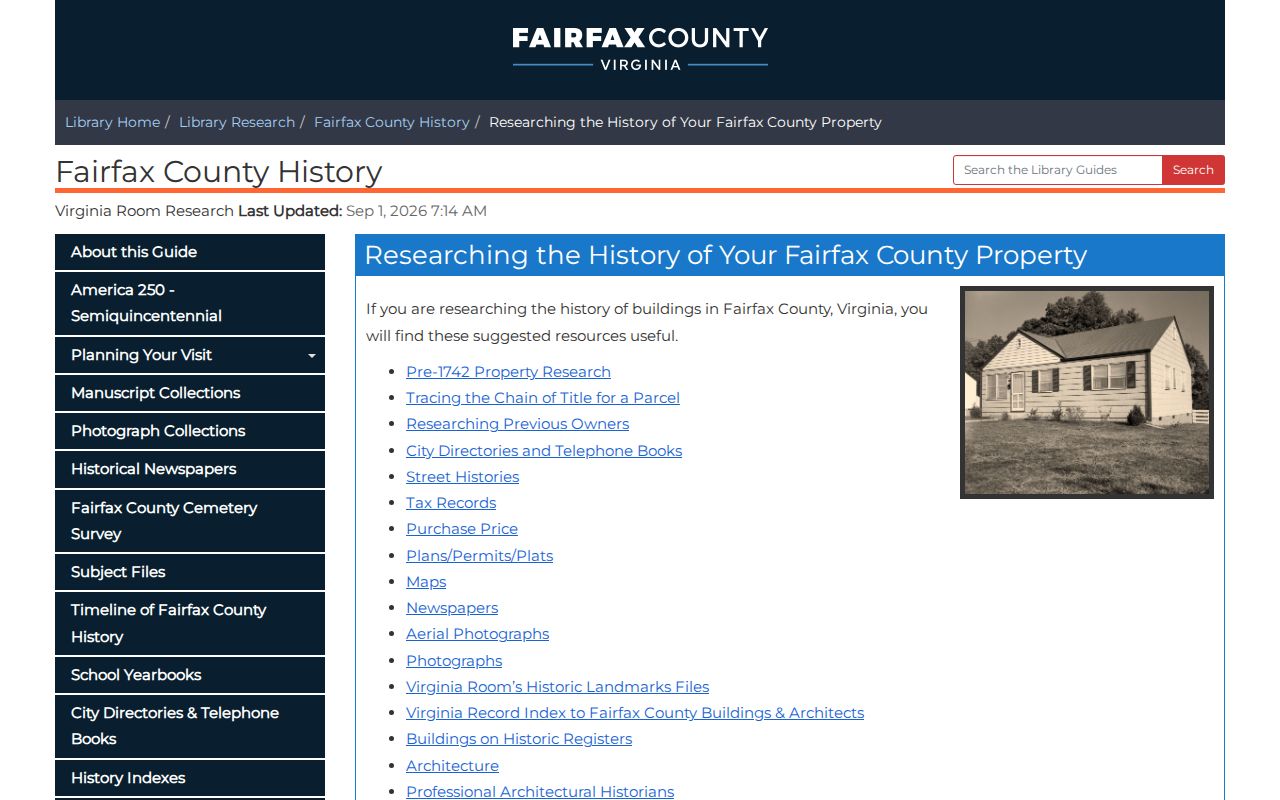
Virginia Room newspaper indexes and microform can add a Lincolnia street, subdivision, civic-club, plan, or property reference to the Lincolnia chronology. Retain the publication date and page or image source, and check reuse rights before reproducing a scan.
Read Lincolnia Record Gaps Carefully
A missing early record is not proof that no Lincolnia transaction or household existed. The Library of Virginia warns that original Fairfax wills, deeds, loose papers, and many pre-Civil-War minute books were damaged or destroyed during the Civil War. Many Fairfax deed books from 1763 through 1819 are missing. Fairfax Historic Records Center holdings and Library of Virginia microfilm can provide surviving material relating to Lincolnia, but a negative result must remain inconclusive.
That Lincolnia caution also applies to the apparent absence of a Lincolnia directory issue, a street listing, or a map sheet. The official research did not establish a continuous Lincolnia-specific directory run or a local Sanborn sheet. Use surviving Lincolnia deeds, tax books, maps, newspapers, and catalog records as separate evidence, and label each gap instead of filling it with an assumption.
Historic-search caution. A failed pre-Civil-War Fairfax search does not prove that a Lincolnia deed, household, or related record never existed.
Place Lincolnia History on Maps
Fairfax property-map books, available by annual series from 1960, and historic or current aerials can show physical change around a Lincolnia parcel. Use the Digital Map Viewer with a map year and tile, then compare the image with the PIN, deed, or subdivision reference. A map can document context for a road or lot, but it cannot establish legal boundaries, ownership, or identity on its own.
Lincolnia Park supplies a dated civic context, not a member roster. Its community history says the Lincolnia Park Civic Association formed in 1956, negotiated a $15,000 club purchase, planned 385 shares, sold 194, and opened the recreational club in summer 1957. That institutional history can anchor a neighborhood timeline beside maps and newspapers without identifying individual residents.
Frame Lincolnia Past Households Safely
Previous residents research should report a method, source date, custodian, and record role. A Lincolnia deed party may be an owner or trustee. A tax entry may be an assessment name. A directory entry may show a published address at one time. A census record describes a historical household within its release rules. Each source helps explain who lived here before, but no one of them supports a current personal profile.
Use newspaper and obituary research as follow-up context only when a dated source supports it. Probate may be a useful estate-record route, but it can contain sensitive family and financial information. When a historical Alexandria label appears, return to the PIN, legal description, or political-jurisdiction layer before deciding between Fairfax County and the independent City of Alexandria.
Lawful use. Use Lincolnia previous residents records for family history, house history, estate research, and personal curiosity. Do not use a result to track, harass, or harm a living person.