
Lincolnia City Directory Holdings
Lincolnia has no separate municipal archive or continuous local volume. The useful shelf is the Fairfax County collection, where regional books, telephone directories, and reverse-address volumes overlap the community at different times. The Fairfax historical directories guide identifies the runs and should be checked before a visit because a title can be held without every year. A listing is evidence of what a publisher printed for that edition, not proof that a person lived at the address before or after it.
| Collection | Years | Where Held | Access |
|---|---|---|---|
| Chataigne Fairfax listings | 1877, 1880, 1884, 1888, 1890, 1897 | Fairfax Virginia Room | Consult the directory guide and room collection |
| P. P. Mast and Hill's Fairfax directories | 1878; 1906 and 1911 | Fairfax Virginia Room | In-person historical collection |
| Alexandria suburban Fairfax County criss-cross | 1966, 1968, 1969, 1971-1973 | Fairfax Virginia Room | Reverse-address research lead |
| Northern Virginia and neighborhood telephone books | 1962-2018; Lincolnia-area issues, 1978-2009 unevenly | Fairfax Virginia Room | Check issue availability before travel |
Gaps are part of the record. The guide identifies a Lincolnia Park Directory, but the inspected guide did not show its year or call number. Record that uncertainty, then ask staff to check the catalog rather than treating the title as a complete series.
Lincolnia City Directories at Virginia Room
The Virginia Room is on the second floor of City of Fairfax Regional Library, 10360 North Street, Fairfax, VA 22030. It holds local and regional history and genealogy books, maps, photographs, manuscripts, newspapers, rare books, city and telephone books, and organization files. Eight web stations, a CPAN station, and a microform reader-printer with USB support make it the practical fallback when an online snippet is not enough. Contact the room at 703-293-6227, option 6, or va_room@fairfaxcounty.gov. Published hours are Monday through Wednesday, 10 a.m. to 9 p.m., and Thursday through Sunday, 10 a.m. to 6 p.m.; check current alerts before going.
The Virginia Room’s official page is the first stop for access details. Bring a list of surnames, spellings, streets, and years. Staff can help locate a volume or reader, but the directory itself should be read carefully for its coverage and abbreviations.
The Fairfax directory guide shows how the collection is arranged and why a county or regional title can be more useful than a book labeled only for Lincolnia.
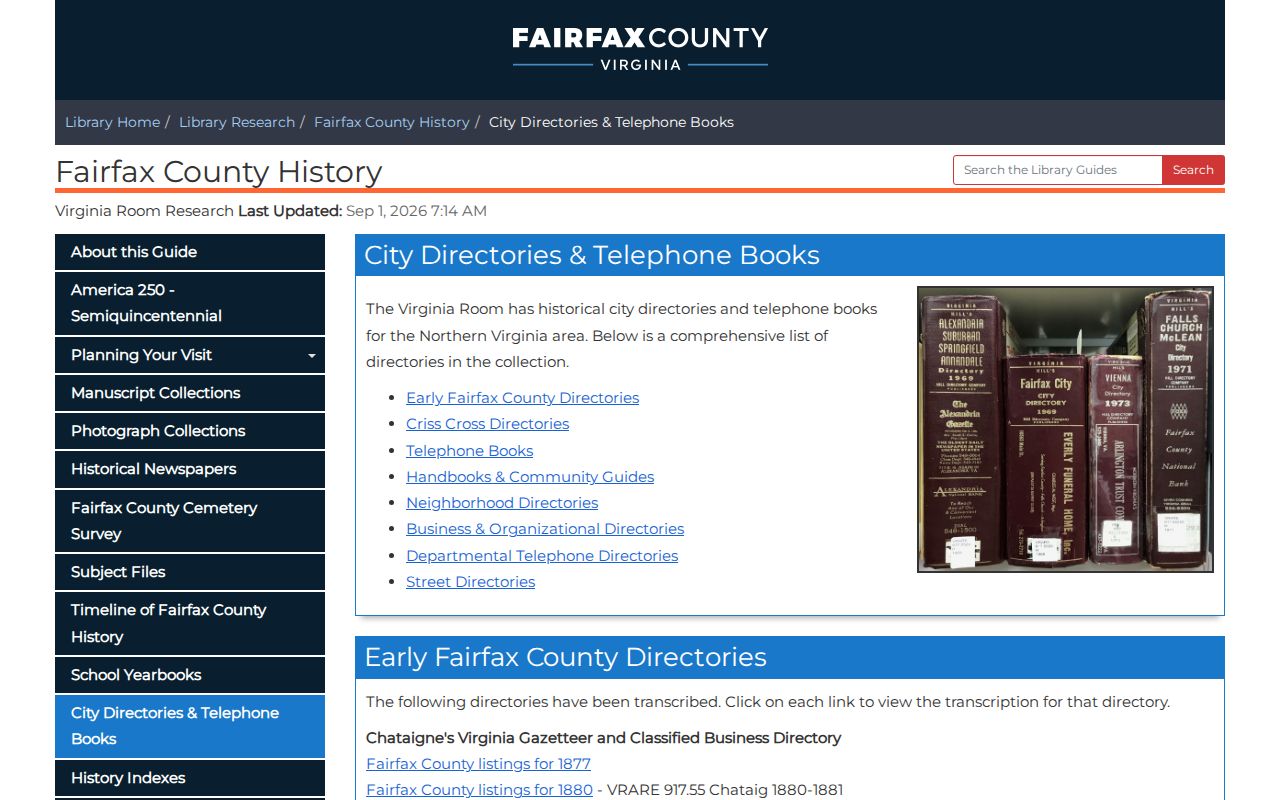
Use the guide as a shelf map, then keep the volume title and publication year with every note or photograph.
Alexandria Labels in Lincolnia Volumes
“Alexandria” on a cover or entry can be a postal-city clue rather than proof that the independent City of Alexandria held the record. Lincolnia is an unincorporated Fairfax County community, and the usual mailing city is Alexandria. Confirm a historical address through a parcel, PIN, deed legal description, map book, or political-jurisdiction layer before moving a Fairfax County lead into a City of Alexandria collection. The suburban Fairfax County directory includes Springfield and Annandale, so it is useful for a lead, not a substitute for an address check.
Neighborhood terms can also move across records. Fairland, Indian Run Park, Lincolnia Park, Little River Village, Lincolnia Mews, and Lincolnia Hills or Heywood Glen may help find an entry, but none alone establishes the present-day boundary. Note: Postal city, county, subdivision, and directory coverage are separate facts.
Lincolnia Telephone Directory Evidence
Telephone volumes can bridge years when a standard directory is absent. Fairfax holds Northern Virginia and Washington white pages from 1962 through 2018 and yellow pages from 1975 through 2018. Its Alexandria, Annandale, and Lincolnia neighborhood runs include 1978, 1982, 1986, 1988, 1988-90, 1990-91, 1991-92, 1993-94, 2001-02, 2004-05, 2005-06, and 2008-09. Those dates describe published issues, not an unbroken series.
Phone listings are historical address clues. They are not permission to contact a number and do not establish a current connection. Haines directories from the early 1970s to the present are available at Arlington’s Center for Local History; confirm that collection’s access rules before relying on it for a Fairfax address.
Read a Lincolnia Directory Entry
Read an entry as a compact, dated inventory rather than as a full biography. The exact fields differ by publisher and year. Capture the page and publication year before expanding a name into other records. A business listing may be separate from a household or county entry, and an occupancy mark is not a deed.
| Name | Published person or business name, including initials, spouse reference, or widow notation when printed. |
|---|---|
| Occupation or business | Published trade or business description, which can distinguish same-name entries. |
| Address or post office | Street address, route, post office, or business location for that edition. |
| Occupancy indicator | Any residence or business notation only if that volume defines it. |
| Publication evidence | Page, publication year, and whether the entry is household, business, or county-wide. |
- Criss-cross directory
- A reverse section arranged by street and number, used to find the name a publisher attached to an address in that edition.
- Householder index
- A name arrangement focused on household heads or named residents, which may omit other people at the address.
- Abbreviation key
- The volume’s explanation of shortened terms and symbols. Photograph or transcribe it before interpreting a mark.
Criss-Cross Books for Lincolnia Addresses
Falls Church criss-cross volumes for 1957, 1959, 1961, 1963, 1965, 1967, and 1969 through 1975 can overlap western or northern Fairfax research. They do not automatically cover Lincolnia. The Alexandria suburban Fairfax County series is a better starting point for the relevant 1966-1973 period, but the returned address still needs a county and PIN check. The City of Alexandria criss-cross run, 1938-1980, should not be used for a Lincolnia conclusion without that check.
These books help reconstruct the printed street sequence, but they should not replace the modern address records available through the Lincolnia street address directory when the question is about a current parcel.
Lincolnia Directory Shelf Limits
Myth: every old address appears online or in one complete run. Fairfax’s directory history is distributed among gazetteers, county books, regional white pages, criss-cross sections, and neighborhood titles. Early Fairfax records also have a Civil War loss problem: portions of original deeds, wills, loose papers, and minute books did not survive. A failed search in an old volume does not prove a person, household, or address was absent.
For a negative result, check a nearby year, a name variant, the printed abbreviation key, and a different collection type. The Library of Virginia Fairfax microfilm guide and Fairfax Historic Records Center are useful next paths for underlying historical records. Note: Preserve an unsuccessful search date and exact title, since missing years matter.
Trace Lincolnia Directory Households
A name becomes more dependable when it is followed through a dated sequence. Census records are public through 1950, so they are a useful fixed point between older directory entries. Tax books and deeds can add the property side of the story, while the directory supplies a period address or business clue. Keep contradictions visible instead of forcing two similar names into one household.
- Start with the earliest confirmed name, street, or post-office entry and copy the page and publication year.
- Search the next available issue, recording spelling changes, initials, spouse or widow references, and address changes.
- Use a criss-cross section only for the address printed in that same edition, then label it as a publication lead.
- Pair a directory year with the public census closest to it and compare the household without assuming every person was listed.
- Check tax books, deeds, probate, or a newspaper date for a move, death, or transfer, keeping the custodian and source citation.
A disappearance can mean a move, death, unlisted phone, missed edition, or a change in coverage. It does not have one automatic meaning. Note: Store the exact address form, not a modernized version, until the geographic match is verified.
Lincolnia Newspaper Companions
Historical newspapers can supply the event around an address or neighborhood term: a civic meeting, road project, plan change, obituary, or property notice. The Virginia Room newspaper index guide and its microform route are the appropriate starting points. Search “Lincolnia,” “Mason,” a subdivision name, street, or organization name, then preserve the newspaper title, issue date, page, and reuse terms.
Do not treat a newspaper reference as a full address history by itself. Pair it with the directory year and the relevant county record. That pairing keeps a local story from becoming an unsupported identity claim.
Lincolnia Directory History Context
The Fairfax History Commission offers county preservation context rather than directory custody. Its resources can help place a place name, plan reference, or community institution beside the printed address trail. The commission should not be used as proof that a particular household lived at a particular location.
The commission’s official history resources provide the source context for this local historical research.
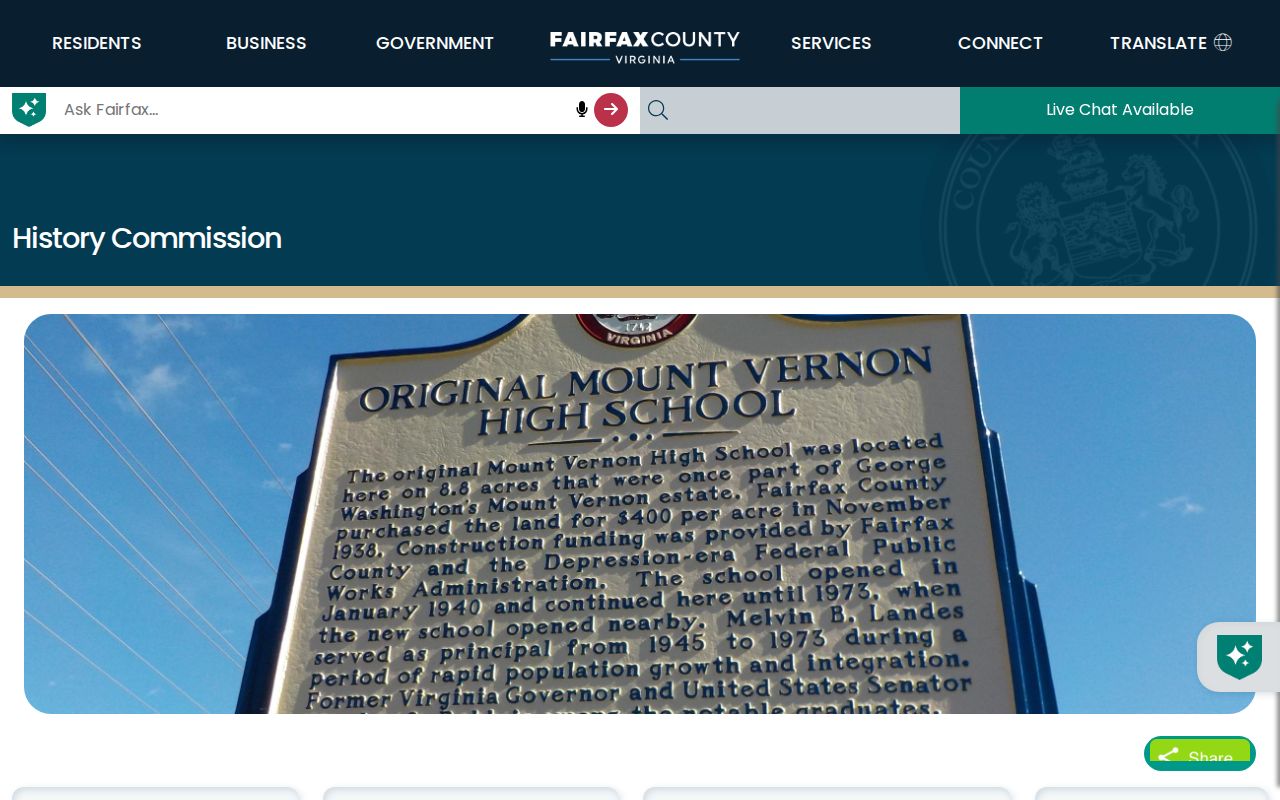
Use a preservation source to refine the local setting, then return to the dated directory and public custodian for the underlying record.